
Whether you are building reporting grids, seeding data warehouses, or creating permutation matrices, understanding how the SQL query engine processes a cross join is essential for writing high-performance, enterprise-grade queries. Let’s walk through the mechanics, risks, and optimization strategies for mastering SQL CROSS JOIN.
SQL CROSS JOIN
Defining the Core Engine Mechanics
To understand a CROSS JOIN, you must look past basic syntax and look at relational algebra. In standard relational database theory, a cross join is the literal implementation of a Cartesian product.
Unlike an INNER JOIN or a LEFT JOIN, which rely on an evaluation predicate (the ON clause) to stitch data together based on matching primary or foreign keys, a CROSS JOIN is completely unconstrained.
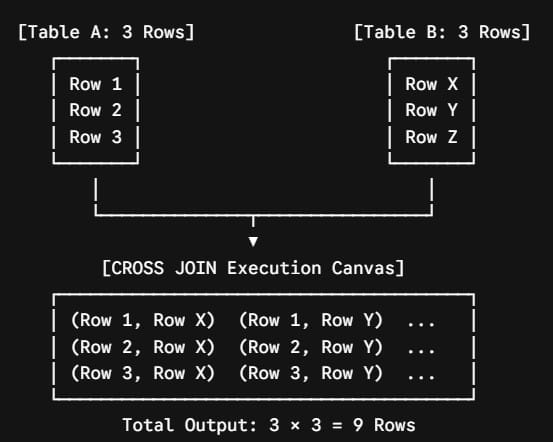
When the query planner encounters a cross join, it instructs the database execution engine to pair every single row from the left table with every single row from the right table. The engine does not look for similarities or shared identifiers. It simply builds an exhaustive, multi-dimensional matrix containing every possible combination of rows between the two datasets.
The Multiplicative Row-Growth Equation
The most important characteristic of a CROSS JOIN is its mathematical density. Because it pairs every row from the first table with every row from the second, the size of the final result set is strictly multiplicative.
The math is absolute:
$$\text{Total Result Rows} = (\text{Rows in Table A}) \times (\text{Rows in Table B})$$
Let’s look at how row counts scale as datasets grow:
| Rows in Table A | Rows in Table B | Total Output Rows | Storage & Performance Risk Profile |
| 10 | 5 | 50 | Negligible; safe for any environment |
| 150 | 20 | 3,000 | Low; processes in milliseconds |
| 5,000 | 200 | 1,000,000 | Moderate; requires monitored memory grant |
| 100,000 | 1,000 | 100,000,000 | High; will trigger heavy disk I/O swapping |
| 1,000,000 | 10,000 | 10,000,000,000 | Critical; high risk of server resource exhaustion |
Syntax Architecture: Explicit vs. Implicit Declarations
In SQL, there are two primary ways to declare a Cartesian product: the modern ANSI-SQL explicit standard and the legacy implicit comma-separated syntax.
The Explicit Standard (Recommended)
The explicit syntax uses the dedicated CROSS JOIN keyword. It separates the tables cleanly and clearly states the developer’s architectural intent:
SQL
SELECT
    Facility.LocationName,
    Shift.TimeBlock
FROM OperationalFacilities AS Facility
CROSS JOIN CorporateShifts AS Shift;
Notice that there is no ON clause. Adding an ON keyword to an explicit CROSS JOIN will cause a syntax error in almost all modern SQL dialects.
The Implicit Standard (Legacy Banned Practice)
The implicit syntax completely omits the join keyword. Instead, it lists the tables in the FROM clause separated by a comma:
SQL
SELECT
    Facility.LocationName,
    Shift.TimeBlock
FROM OperationalFacilities AS Facility, CorporateShifts AS Shift;
While this implicit syntax is still supported by modern RDBMS engines for backward compatibility, I forbid its use in any production codebase I govern.
Why? Because the implicit syntax looks identical to a standard inner join where the developer simply forgot to add the WHERE or ON filtering clauses. It introduces unnecessary ambiguity, increases technical debt, and can confuse code reviewers trying to differentiate between an intentional Cartesian product and an accidental bug.
When to Use a CROSS JOIN: Enterprise Design Patterns
Given the performance risks of combinatorial data explosion, you might wonder why we use this operator at all. A CROSS JOIN is highly effective when your data model requires an exhaustive framework of permutations.
Pattern 1: Generating Reporting and Analytics Grids
In business intelligence and data warehousing platforms, analysts frequently require reports that display data across every possible combination of variables—such as tracking every product variant across every calendar day, regardless of whether a sale actually occurred.
If you left-join a sparse sales table to a calendar table, any dates without sales will disappear from the output. By cross-joining a master product list with a calendar table first, you build a dense baseline grid. You can then left-join your transactional data against this grid to ensure your final reports display clean, zero-filled rows for inactive days.
Pattern 2: Seeding Combinatorial Configurations
When initializing complex software systems—such as setting up testing suites, scheduling applications, or logistics matrices—you often need to populate a table with an initial state of combinations.
- Mapping every employee role to every security permissions ring.
- Pairing every manufacturing plant location with every product line.
- Generating exhaustive routing matrices for supply chain simulation.
Pattern 3: Matrix Transformations and Data Unpivoting
Advanced data engineering pipelines often use small cross joins against static helper tables (e.g., a table containing sequential integers) to duplicate rows deliberately. This technique is highly effective for unpacking compressed data blocks, converting delimited strings into tabular structures, or manual unpivoting transformations when native operators are unavailable.
Performance Optimization and Risk Mitigation
If your architecture requires a CROSS JOIN, you must take proactive measures to protect your system from resource starvation.
The Filtered Cross Join
I often see developers attempt to optimize their queries by appending a WHERE clause directly to a cross join:
SQL
SELECT A.Field, B.Field
FROM TableA AS A
CROSS JOIN TableB AS B
WHERE A.IdentityKey = B.IdentityKey;
Logically, this query produces the exact same result as a standard INNER JOIN. In an ideal world, the RDBMS query optimizer will recognize this pattern, transform the execution plan, and run it as an inner join under the hood.
However, relying on the optimizer to fix inefficient syntax is risky. If your query includes complex subqueries, window functions, or nested views, the query optimizer can easily miscalculate the cardinality. It may execute a literal, multi-million-row Cartesian product in memory first, and then apply the WHERE filter afterward.
Always use an explicit INNER JOIN if you intend to filter down records using shared keys.
Protecting Your Engines with CTEs and Subqueries
To keep a cross join safe, reduce the row count of your input datasets before the join occurs. Never cross-join two massive base tables if you only intend to work with a subset of their data.
Instead, wrap your filtering logic inside Common Table Expressions (CTEs) or localized subqueries to isolate the exact dataset required:
SQL
WITH FilteredFacilities AS (
    SELECT LocationName
    FROM OperationalFacilities
    WHERE Region = 'NorthEast' -- Contricts input rows early
),
TargetShifts AS (
    SELECT TimeBlock
    FROM CorporateShifts
    WHERE IsActive = 1
)
SELECT
    Fac.LocationName,
    Sft.TimeBlock
FROM FilteredFacilities AS Fac
CROSS JOIN TargetShifts AS Sft;
By filtering your inputs early, you minimize the size of the Cartesian matrix, protect the server’s buffer pool, and keep execution paths fast and predictable.
Conclusion
By mastering the underlying mechanics of the CROSS JOIN and enforcing strict input boundaries, you eliminate the risk of unexpected query slowdowns. This allows you to build highly reliable, scalable, and performant data layers across your cloud integration infrastructure.
You may also like the following articles:

After working for more than 15 years in the Software field, especially in Microsoft technologies, I have decided to share my expert knowledge of SQL Server. Check out all the SQL Server and related database tutorials I have shared here. Most of the readers are from countries like the United States of America, the United Kingdom, New Zealand, Australia, Canada, etc. I am also a Microsoft MVP. Check out more here.