
In this comprehensive tutorial, I will clarify the distinctions between these two critical constraints, Primary Key vs Unique Key, explain their underlying mechanics, and share the architectural rules of thumb I use to determine exactly when to apply each.
Primary Key vs Unique Key
The Core Concept of Uniqueness Constraints
Before contrasting these keys, it is essential to understand why relational database management systems (RDBMS) provide both. Relational databases are built on set theory, which dictates that rows within an entity set must be distinctly identifiable.
To enforce this, database engines utilize uniqueness constraints. When you apply either a Primary Key or a Unique Key to a column, you instruct the internal database engine to create an underlying unique index. Every time a transaction attempts to insert or update a row, the engine scans this index to guarantee that the incoming value does not conflict with existing data.
While their defensive objective is identical—blocking duplicate data entry—their structural design rules and behavioral properties are distinctly different.
What is a Primary Key?
As I evaluate data models, I define the Primary Key as the ultimate identifier for an entity. It serves as the primary gateway to every row within a table. A table can possess one, and only one, primary key.
Strict Structural Properties of a Primary Key
The database engine enforces two absolute constraints on a primary key:
- Non-Nullability: A primary key column can never contain a
NULLvalue. It requires a tangible, concrete value for the row to exist. - Physical Data Organization: In default database configurations, the primary key dictates the table’s Clustered Index. This means the database engine physically arranges the rows on the disk storage media in the exact sequential order of the primary key values. Because of this physical alignment, querying a table by its primary key is the fastest possible lookup operation.
What is a Unique Key?
A Unique Key constraint ensures that all values in a column (or a combination of columns) are distinct from one another. However, unlike a primary key, its purpose is not to serve as the structural backbone of the table, but rather to protect secondary business attributes from duplicate entry.
Distinguishing Traits of a Unique Key
- Permissibility of Nulls: A unique key column allows for the presence of
NULLvalues. It can accept an “unknown” or “missing” state while still protecting the column from duplicate concrete values. - Logical Indexing: By default, assigning a unique key constraint creates a Non-Clustered Index. The physical rows on disk remain organized by the clustered index (the primary key), while a separate, logical index pointer is generated specifically to track the unique key values.
- Multi-Instance Application: A single table is strictly limited to one primary key, but it can accommodate virtually unlimited unique key constraints across different columns.
Primary Key vs. Unique Key: Feature Matrix
| Architectural Feature | Primary Key | Unique Key |
| Quantity Per Table | Strictly limited to one per table. | Multiple constraints permitted per table. |
| Null Value Allowance | Completely forbidden (NOT NULL is strictly enforced). | Allowed (Behavior varies slightly by RDBMS). |
| Default Index Type | Clustered Index (Physically sorts data on disk). | Non-Clustered Index (Creates a secondary lookup structure). |
| Primary Structural Purpose | Enforces entity integrity and serves as the relationship anchor. | Enforces secondary business logic constraints. |
| Foreign Key Targeted Destination | The standard, universally preferred target for relationships. | Permitted as a target, though rarely recommended. |
Deep Dive: The Critical Nuances of Null Handling
The handling of NULL values is a frequent source of confusion during database design reviews. It is vital to understand exactly how database engines evaluate NULL against uniqueness constraints.
As established, a Primary Key explicitly rejects NULL values at the gateway. A Unique Key, however, welcomes NULL values, but the exact implementation depends on the specific database engine you are running. This variance is governed by how individual platforms interpret the SQL standard.
- The Single-Null Constraint (Microsoft SQL Server): SQL Server treats a
NULLas a distinct, concrete value under a unique constraint. Consequently, it allows only one row in that column to contain aNULL. A second attempt to insert aNULLwill trigger a constraint violation error. - The Multi-Null Approach (Oracle, PostgreSQL, MySQL): These engines adhere strictly to the philosophy that
NULLrepresents an completely unknown value. Because one unknown value cannot technically equal another unknown value, these platforms permit multiple rows to containNULLvalues within a unique key column without violating the constraint.
Recommendation: If you are deploying database schemas to Microsoft SQL Server and require multiple rows to contain a
NULLwhile preserving uniqueness for actual values, do not rely on a standard unique constraint alone. Instead, implement a Filtered Unique Index that explicitly excludes null values from the uniqueness evaluation.
Indexing Mechanics: Clustered vs. Non-Clustered Performance
To write high-performance queries, you must understand how these keys alter disk-level read and write paths.
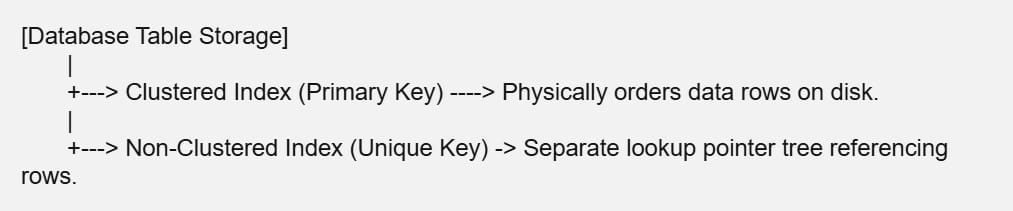
When a query requests data via a Primary Key, the engine traverses the clustered B-tree index and immediately arrives at the physical data row. No secondary lookups or pointer jumps are required. This makes primary keys optimal for high-throughput, point-lookup transactional queries.
Conversely, a Unique Key utilizes a non-clustered index structure. When a query filters by a unique key, the engine finds the value within the non-clustered index tree, extracts the row locator pointer, and performs an additional read operation to retrieve the actual row from the physical storage layer.
This minor overhead makes unique keys slightly less optimal for heavy, system-critical read operations compared to primary keys, though they remain vastly superior to scanning unindexed columns.
How to Strategically Assign Keys in Enterprise Models
When designing enterprise systems, mapping real-world business requirements to the correct database structures requires a methodical approach.
1. Determining the Primary Key Destination
Every table in an enterprise ecosystem requires a primary key to anchor its identity. I strongly recommend utilizing an internal, system-generated Surrogate Key (such as an auto-incrementing integer sequence or a globally unique identifier) as your primary key.
This isolates your physical database relationships from volatile business logic adjustments. The primary key should be lightweight, immutable, and fully non-nullable.
2. Safeguarding the Perimeter with Unique Keys
Once your primary key is established to handle internal system mapping, you must protect your business-facing identifiers. Attributes such as employee identification codes, corporate email addresses, state tax registration numbers, and global asset tracking tags must remain completely unique across your enterprise landscape.
These attributes are the ideal candidates for Unique Keys. Applying a unique key constraint to these columns protects your database against duplicate data entry from client applications, while leaving your clean, immutable primary key free to manage internal table joins.
Key Restrictions and Relational Capabilities
An advanced architectural point to consider is how these constraints interact with Foreign Keys when mapping data relationships across tables.
A foreign key configuration requires a reliable target in the parent table. Because a primary key is guaranteed to be unique and completely non-nullable, it is the universal standard target for establishing foreign key relationships.
However, many engineers are unaware that a Unique Key column is also a legally valid target for a Foreign Key constraint. Relational engines permit this because the underlying index guarantees uniqueness, which satisfies the mathematical requirements for a relational join.
Despite being technically permissible, using a unique key as a foreign key target is an anti-pattern that I advise against in core enterprise tables. If the targeted unique key allows NULL values, tracking referential integrity across child tables becomes unpredictable and highly complex to maintain. Keep your relationships anchored explicitly to your primary keys.
Common Structural Mistakes to Avoid
- Failing to Enforce Unique Constraints on Alternate Keys: Choosing a surrogate primary key does not absolve you from protecting your business rules. If you use an auto-incrementing ID as your primary key but neglect to place a unique key constraint on your user email column, your application will eventually suffer from duplicate account generation.
- Declaring Multiple Primary Keys: Relational design frameworks do not support multiple independent primary keys on a single table. If you require multiple columns to be unique, select one to serve as your singular primary key and handle the remaining columns with unique key constraints.
- Ignoring Index Overhead During Massive Bulk Operations: Every unique key constraint added to a table introduces a secondary non-clustered index. If a table contains five different unique keys, every single insert or bulk-load operation forces the database engine to update five distinct index trees in real-time. Balance your data validation needs against write performance requirements.
Final Review
Mastering the distinct behaviors of primary keys and unique keys is essential for creating high-performance, resilient database architectures. Use your single primary key as an immutable, non-nullable foundation to define a row’s physical existence and drive relational table joins.
Deploy multiple unique key constraints as a flexible defensive layer to safeguard your business-facing attributes against duplication. By aligning these constraints with their native indexing and structural profiles, you ensure your data architecture remains accurate, stable, and highly performant as your organization scales.
You may also like the following articles:
- SQL DISTINCT vs UNIQUE
- Get Primary Key Of Table SQL Server
- SQL Server Add Primary Key To Existing Table

After working for more than 15 years in the Software field, especially in Microsoft technologies, I have decided to share my expert knowledge of SQL Server. Check out all the SQL Server and related database tutorials I have shared here. Most of the readers are from countries like the United States of America, the United Kingdom, New Zealand, Australia, Canada, etc. I am also a Microsoft MVP. Check out more here.