
In this comprehensive tutorial, we will explore how Dynamic SQL functions, when to use it, and how to execute it securely at an enterprise scale.
Dynamic SQL
What is Dynamic SQL?
Dynamic SQL is a programming technique that allows you to construct a SQL query as a text string dynamically at runtime, compile that string into executable code, and run it on the database engine.
To understand the core paradigm shift, consider how the relational engine processes a traditional query versus a dynamic query:
- Static SQL: The database engine receives a completely predetermined query text. It can immediately analyze the syntax, check permissions, and optimize an execution plan. The structure of the statement remains identical every single time it runs.
- Dynamic SQL: The database treats your initial code as a string manipulation script. Your code concatenates variables, applies string logic, and builds a query string while the application or stored procedure is executing. Only after the string is fully assembled does the database engine parse, compile, and execute the final command.
The Primary Use Cases for Dynamic SQL
Dynamic SQL should never be your default choice when writing database logic; it should be applied deliberately when static SQL cannot mathematically or logically achieve the desired outcome. In production systems, there are three primary scenarios where this pattern is necessary:
1. Advanced, Multi-Attribute Search Engines
Consider an enterprise application dashboard where a business analyst can filter a dataset using twenty different optional fields (e.g., filtering by region, date ranges, department codes, manager IDs, or transaction types).
Writing this in static SQL usually results in a massive, un-optimizable WHERE clause packed with conditions like WHERE (@Region IS NULL OR region = @Region) AND (@ManagerID IS NULL OR manager_id = @ManagerID).
This pattern frequently confuses the query optimizer, leading to terrible execution plans. Dynamic SQL solves this by evaluating which filters are active and only generating the exact WHERE clauses required for that specific search.
2. Dynamic Sorting (ORDER BY Variables)
Standard SQL does not natively allow you to pass a variable directly into an ORDER BY clause to determine the sorting column (e.g., ORDER BY @SortColumnDirection). While you can implement a workaround using a complex CASE statement, it often breaks index usage and slows down performance on large datasets. Dynamic SQL allows you to cleanly append the user’s chosen column and direction string straight into the query block.
3. Metadata and Automated Administrative Scripts
If you are responsible for automated database maintenance—such as a nightly routine that loops through every table in a schema to rebuild fragmented indexes, or a script that automatically partitions incoming archive tables named with a changing date suffix (like sales_archive_2026_07)—Dynamic SQL is required. Since table and column identifiers cannot be parameterized in static SQL, you must use dynamic string construction to run these administrative commands.
Execution Mechanisms: Choosing Your Toolkit
1. The Native EXEC / EXECUTE Command
This is the most straightforward method. You simply build a string variable and pass it straight to the execution operator.
- Characteristics: It is easy to write but highly rigid.
- Architectural Flaw: It does not naturally support input or output parameterization. This forces developers into unsafe string concatenation patterns, which can severely degrade performance and introduce security risks.
2. Specialized System Procedures (e.g., sp_executesql)
In professional configurations, this is the preferred approach for running dynamic statements. This system procedure acts as an execution gateway that accepts the dynamic query string along with explicit parameter definitions.
- Characteristics: It treats inputs as true strongly-typed parameters rather than raw text additions.
- Architectural Advantage: By keeping parameters separated from the core statement, it allows the database engine to reuse cached execution plans, while blocking the injection of malicious code.
Side-by-Side Comparison: Static vs. Dynamic SQL
To help you determine which model fits your current feature branch, consider this side-by-side technical breakdown:
| Architectural Dimension | Static SQL | Dynamic SQL |
| Compilation Time | Compiled ahead of time during object creation. | Compiled at runtime, immediately before execution. |
| Execution Plan Reuse | High. Highly predictable plans are easily cached. | Conditional. Depends entirely on parameterization. |
| Security Boundary | High protection. Naturally blocks injection attacks. | Vulnerable by default. Requires active validation. |
| Permissions Model | Standard object-level access controls apply. | May require elevated schema rights to run. |
| Maintainability | Clean. Caught by compile-time linting tools. | Complex. Requires debugging raw text strings. |
The Greatest Threat: Defeating SQL Injection Attacks
You cannot discuss Dynamic SQL without discussing security. When you build queries out of raw text strings, you open the door to SQL Injection (SQLi)—one of the most devastating vulnerabilities in data security.
If a developer builds a query by directly gluing user text input into a dynamic string (e.g., assembling text like 'SELECT * FROM customers WHERE account_name = ''' + UserInput + ''''), a malicious actor can exploit this. By entering a payload containing special characters and commands (such as ' US-West-1'; DROP TABLE customers; --), they can trick the database engine into executing unintended code, potentially wiping out entire production systems.
The Defensive Blueprint
To completely eliminate SQL injection threats within your dynamic queries, apply these two foundational security controls:
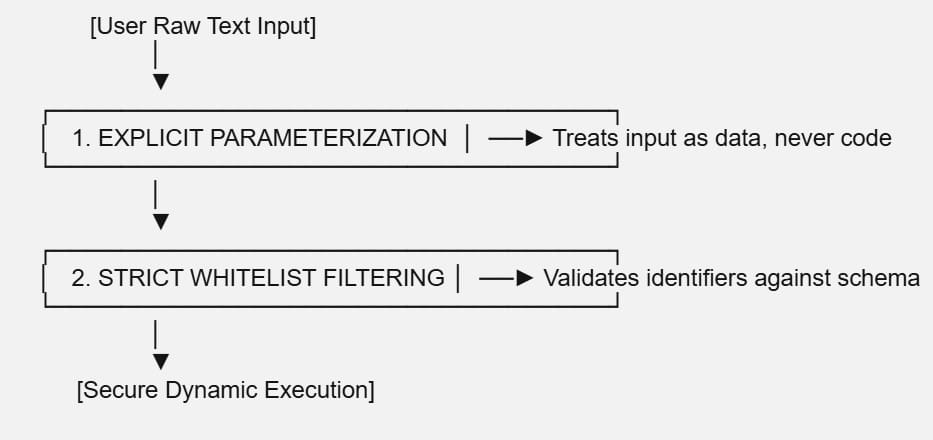
1. Mandate Explicit Parameterization
Never stitch raw input data into a dynamic string. Instead, embed standard parameter placeholders (like @ParamName or :ParamName) directly inside your text blueprint, and pass the values using an engine’s parameterized execution tools (like sp_executesql). This instructs the query engine to treat the input strictly as a safe literal data value, ensuring it never runs as executable code.
2. Enforce Strict Whitelist Filtering for Identifiers
Parameters are excellent for data values, but they cannot be used for structural objects like table names, column names, or sort orders. If a user interface allows an analyst to select a target sorting column from a dropdown menu, you must validate that input against a strict, predefined whitelist before injecting it into your code block.
Verify the string against known schema columns or wrap identifiers in native sanitization functions (such as QUOTENAME() in SQL Server) to ensure that unexpected characters are neutralized before execution.
Performance Management and Plan Caching
A common misconception among database engineers is that Dynamic SQL always destroys database performance. This belief stems from watching poorly written systems suffer from Plan Cache Inflation.
Every time a SQL statement executes, the query optimizer works to build an efficient execution plan. This plan is stored in the database’s memory cache so future identical queries can skip the expensive optimization step.
Preventing Cache Pollution
If you use string concatenation to build your queries, every variation in input data creates a completely unique query string (e.g., ... WHERE id = 101 vs. ... WHERE id = 102). The query optimizer views these as two completely unrelated statements, forcing it to generate and cache a brand-new execution plan for every request. This can quickly saturate your database’s memory with single-use plans, pushing valuable operational data out of the cache.
By using true parameterization within your dynamic code, the underlying statement remains structurally identical across calls (e.g., ... WHERE id = @TargetID). This allows the database engine to find the existing cached plan, saving valuable CPU cycles and ensuring your applications run smoothly under heavy enterprise loads.
Conclusion:
Dynamic SQL is a powerful architectural pattern that solves complex, runtime data challenges when static code reaches its limits. However, because it shifts syntax evaluation and execution paths to runtime, it demands a higher degree of care and discipline from the development team.
You may also like the following articles:

After working for more than 15 years in the Software field, especially in Microsoft technologies, I have decided to share my expert knowledge of SQL Server. Check out all the SQL Server and related database tutorials I have shared here. Most of the readers are from countries like the United States of America, the United Kingdom, New Zealand, Australia, Canada, etc. I am also a Microsoft MVP. Check out more here.