
As a technical architect and data engineer, I have compiled this comprehensive guide to help you navigate structural modeling, performance tuning, and operational integrity. Let’s explore the essential best practices for SQL database design.
SQL Database Design Best Practices
Establish Structural Discipline with Naming Conventions
Before writing a single line of Data Definition Language (DDL), you must establish strict naming conventions. Inconsistency in table or column naming is a major source of minor errors during development. When engineers are forced to constantly check the schema to see if a field is singular, plural, camelCase, or snake_case, development momentum stalls.
The Authoritative Naming Rules
- Stick to Singular Table Names: Name your tables
Employee,Invoice, andProductrather thanEmployees,Invoices, andProducts. A table is a structural entity definition; the plurality is already implied by its existence. - Avoid Generic Clichés Like
ID: Do not name the primary key of every single table simplyID. When you write complex analytical queries involving ten different table joins, genericIDnames force you to write endless field aliases. Instead, use explicit naming such asCustomerID,OrderID, orVendorID. - Stay Far Away from Reserved Words: Do not use database keywords like
User,Date,Order, orTimestampas column names. Doing so forces you to wrap fields in brackets or escape characters in your queries, which slows down raw development and increases syntax errors. - Enforce Uniform Lowercase Snake_Case: In modern cross-platform environments, stick to lowercase snake_case (e.g.,
billing_address_city). Certain relational engines (like PostgreSQL) default to lowercase and will force case-sensitive string quoting if you accidentally pass PascalCase or CamelCase identifiers.
Implement Progressive Normalization
Normalization is the process of organizing data to minimize redundant duplication and eliminate data anomalies. The golden rule of database schema design remains unchanged: model your domain honestly, normalize first, and denormalize only when a measured bottleneck leaves you no choice.
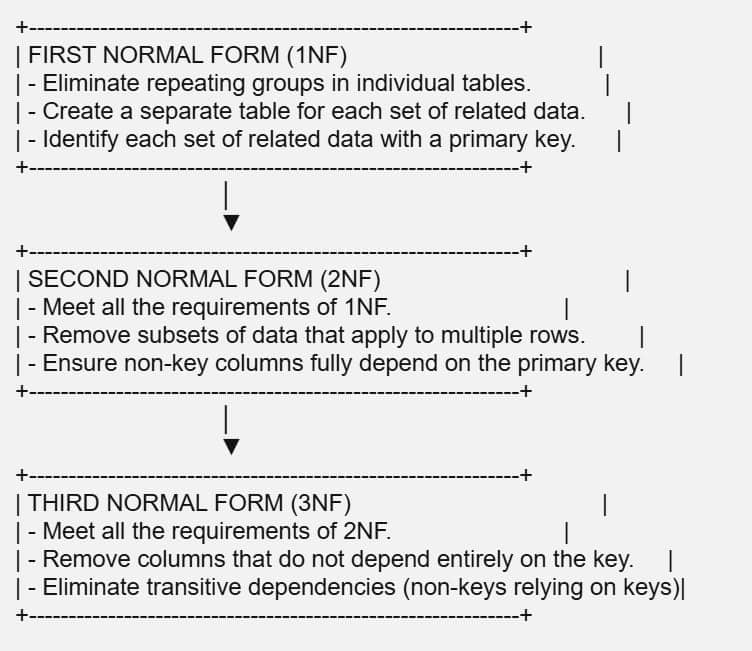
For transactional business applications (OLTP setups), you should target Third Normal Form (3NF) by default.
The Progression of Normal Forms
When to Break the Rules: Denormalization
While normalization ensures data consistency, extreme over-normalization can scatter a single logical entity across a dozen tables, forcing the query engine to perform expensive multi-way joins on basic read requests.
If you are transitioning data into a reporting or decision support system (DSS) where fast reads are favored over real-time transaction speeds, denormalization is an appropriate choice. However, only introduce a duplicate column or a materialized view after execution toolkits (like EXPLAIN ANALYZE) mathematically prove that table joins are causing a real bottleneck.
Formulate a Primary Key Strategy
Every relational database table requires an anchor to uniquely identify its records. When designing this anchor, you face a foundational architectural choice: Surrogate Keys vs. Natural Keys.
The Surrogate Key Advantage
A natural key uses pre-existing data points—such as an individual’s Social Security Number (SSN) or a business’s tax ID—as the unique identifier. Never use sensitive personal information like SSNs or emails as primary keys. Business rules change, people change their emails, and displaying sensitive PII inside foreign key columns across your database creates compliance risk under frameworks like HIPAA or California’s CCPA.
Instead, use Surrogate Keys, which are arbitrary identifiers generated purely for the database layer.
| Key Type | Architectural Trade-offs | Ideal Use Case |
| BIGINT / Identity | 8-byte sequential integer. Highly efficient, maintains sequential page locality inside standard indexes, and scales 20–40x faster on standard reads. | Centralized, single-cluster transactional systems. |
| UUID v7 | 16-byte time-ordered universally unique identifier. Avoid legacy random UUID v4 values, which fragment index trees and double row storage sizes. | Distributed databases or microservices architectures where IDs must be generated without cluster coordination. |
Use Constraints for Database-Level Integrity
Do not rely on upstream client-side applications or API layers to keep your data clean. Frontends change, edge services experience bugs, and internal scripts will bypass your application logic during emergency maintenance. Your database must serve as the ultimate gatekeeper of data integrity.
Explicitly define these four relational constraints directly in your DDL:
- NOT NULL: Enforce this rule on every single column unless a field is truly optional. Allowing unchecked
NULLvariables introduces ambiguity, complicates conditional queries, and can lead to unexpected logic errors during calculations. - FOREIGN KEY: Maintain strict referential integrity by declaring explicit relationships between tables. Set up automated behavioral policies (like
ON DELETE RESTRICTorON DELETE CASCADE) to prevent orphaned child records from cluttering storage. - CHECK: Build fundamental validation rules directly into your storage tier. Use check constraints to ensure a
transaction_amountis always strictly greater than zero, or that ashipping_statusstring strictly contains recognized statuses like'PENDING','SHIPPED', or'DELIVERED'. - UNIQUE: Protect non-primary key identifiers—such as corporate employee IDs or alternate system tokens—from duplicate entry errors.
Check out SQL Constraints for more information.
Design a Intentional Indexing Strategy
Indexing is the primary method for accelerating database read performance, but it represents a careful balancing act. While an index allows your system to avoid full-table scans during a search query, every index you create introduces write overhead. Every time an application executes an INSERT, UPDATE, or DELETE statement, the database engine must recalculate the underlying index trees.
Indexing Optimization Tactics
- Index for Your Search Predicates: Analyze your query history and apply indexes specifically to columns that appear frequently within
WHERE,JOIN,ORDER BY, orGROUP BYoperations. - Default to B-Tree Indexes: For standard scalar data fields, the B-Tree index is your standard option. It handles equality checks, range lookups, and sorting operations efficiently.
- Utilize Composite Indexes Judiciously: If your backend application regularly filters queries using a specific multi-column combination (e.g., searching for users by
last_nameANDzip_codesimultaneously), create a single composite index combining those two fields. Keep in mind that the order of columns matters: place the column with the highest filtering efficiency first. - Prune Wasteful Indexes: Periodically run health checks to identify and drop unused or highly duplicated indexes.
Architect for Security and Data Isolation
When designing modern systems, security should be treated as a core architectural constraint rather than a secondary configuration step.
The Separation of Sensitive PII
To enhance security and simplify compliance audits, isolate Personally Identifiable Information (PII) from your day-to-day operational tables. Place sensitive customer attributes (such as names, phone numbers, and physical addresses) inside a restricted, highly encrypted security vault table.

Link your main operational records to this vault table using anonymized IDs. In the event of a security breach or an unauthorized data export from your core transaction tables, attackers only see anonymous transactional data strings, keeping the underlying human identities safe.
Summary
Building a reliable relational database requires a disciplined approach to structural choices early in the design phase. As you model your next system tier, keep these fundamental practices in mind:
- Naming: Standardize on singular table titles and descriptive lowercase keys.
- Normalization: Normalize your data structure to 3NF initially, and only denormalize based on explicit execution profiling metrics.
- Primary Keys: Choose 8-byte integers for standard deployments, or use sequential UUID v7 keys if you are working with distributed environments.
- Integrity Rules: Move validation checks out of client-side code and enforce them via native SQL constraints.
- Indexing: Index the specific columns used in your filter queries, and regularly monitor system stats to remove unused indexes.
- Isolation: Separate PII into dedicated data vaults to streamline compliance and protect sensitive records.
By maintaining structural discipline and applying these best practices across your data layer, you protect your environment from common performance pitfalls. This results in an agile, well-documented, and highly scalable database architecture that easily supports your enterprise as it grows.
You may also like the following articles:
- What Is SQL Used For
- SQL Cheat Sheet
- Primary Key vs Unique Key
- SQL SELF JOIN Tutorial
- SQL Subquery
- SQL Join Basics

After working for more than 15 years in the Software field, especially in Microsoft technologies, I have decided to share my expert knowledge of SQL Server. Check out all the SQL Server and related database tutorials I have shared here. Most of the readers are from countries like the United States of America, the United Kingdom, New Zealand, Australia, Canada, etc. I am also a Microsoft MVP. Check out more here.