
SQL normalization is the cornerstone of robust relational database management systems (RDBMS). In this comprehensive tutorial, I will walk you through the theoretical principles, structural mechanics, and mathematical logic behind database normalization.
SQL Normalization
What is SQL Normalization?
SQL normalization is the systematic process of organizing data within a relational database to achieve two primary objectives:
- Eliminate redundant data: Storing the same piece of information in multiple places wastes storage and increases cache misses.
- Ensure logical data dependencies: Ensuring that related data items are stored together and dependent values rely strictly on valid primary and candidate keys.
Normalization was first introduced by Edgar F. Codd in 1970 as part of his relational model. It relies on decomposing large, unnormalized tables into smaller, highly focused, and related tables using foreign keys.
The Cost of Poor Schema Design: Data Anomalies
When a schema is poorly structured or left unnormalized, the database becomes vulnerable to three destructive operational flaws known as data anomalies.
1. Insertion Anomaly
An insertion anomaly occurs when you cannot record a piece of data without unnecessarily inserting unrelated information. For instance, if an employee’s department data is stored directly in the employee record, you cannot record a newly created department until at least one employee is hired into it.
2. Update Anomaly
An update anomaly happens when data redundancy forces an application to modify multiple records to reflect a single conceptual change. If an enterprise has 500 records referencing a manager located in Chicago, updating that manager’s office location requires 500 row updates. If even one record fails during the transaction, the database enters an inconsistent state.
3. Deletion Anomaly
A deletion anomaly represents the accidental loss of unintended data when deleting a record. For instance, if a department’s metadata only exists inside the records of the staff assigned to it, removing the last employee in that department permanently erases all institutional knowledge of the department itself.
Core Relational Concepts You Must Understand
Before diving into the normal forms, let’s review the technical terms that govern the mathematical decomposition of relational tables:
- Entity: A distinct real-world object or concept (e.g., Customer, Product, Invoice) represented as a relation/table.
- Attribute: A property or characteristic of an entity (represented as a column).
- Tuple: A single record or row within a table.
- Candidate Key: A minimal set of attributes that uniquely identifies a tuple within a relation.
- Primary Key: The chosen candidate key selected by the database architect to serve as the unique identifier for all tuples in the table.
- Foreign Key: An attribute or collection of attributes in one table that references the primary key of another table.
- Functional Dependency ($X \rightarrow Y$): A constraint between two sets of attributes such that the value of attribute set $X$ uniquely determines the value of attribute set $Y$.
- Composite Key: A primary or candidate key composed of two or more attributes.
First Normal Form (1NF): Atomicity and Uniqueness
A table is in First Normal Form (1NF) if and only if:
- Every column contains only atomic (indivisible) values.
- There are no repeating groups or comma-delimited arrays within a single attribute.
- Each record is uniquely identifiable via a defined primary key.
- The order in which data is stored does not matter.
Unnormalized Representation (Violates 1NF)
Consider an enterprise managing employee skills where multiple values are bundled together:
| EmployeeID | FullName | Location | SkillsAcquired |
| 101 | Sarah Miller | Austin, TX | SQL, Python, Tableau |
| 102 | Michael Davis | Seattle, WA | Java, Docker |
| 103 | Jessica Taylor | Boston, MA | Go, Kubernetes, AWS |
Why this violates 1NF: The SkillsAcquired column holds non-atomic lists, and Location combines city and state. Querying for all employees who know Python requires wildcards (LIKE '%Python%'), bypassing indexes and degrading performance.
1NF Schema Transformation
To normalize to 1NF, we decompose non-atomic values into distinct rows and assign a proper composite primary key ((EmployeeID, Skill)):
| EmployeeID | FirstName | LastName | City | StateCode | Skill |
| 101 | Sarah | Miller | Austin | TX | SQL |
| 101 | Sarah | Miller | Austin | TX | Python |
| 101 | Sarah | Miller | Austin | TX | Tableau |
| 102 | Michael | Davis | Seattle | WA | Java |
| 102 | Michael | Davis | Seattle | WA | Docker |
| 103 | Jessica | Taylor | Boston | MA | Go |
| 103 | Jessica | Taylor | Boston | MA | Kubernetes |
| 103 | Jessica | Taylor | Boston | MA | AWS |
Now, each column is atomic, and every tuple is addressable. However, we have introduced significant redundancy in employee names and locations.
Second Normal Form (2NF): Eliminating Partial Dependencies
A relation is in Second Normal Form (2NF) if:
- It meets all criteria of 1NF.
- It contains no partial dependencies—every non-prime attribute must be fully functionally dependent on the entire primary key, not just a subset of a composite key.
Note: If a 1NF table has a single-attribute primary key, it is automatically in 2NF. 2NF issues only arise when composite primary keys are used.
The 1NF Dependency Problem
In the previous 1NF table, our composite primary key is (EmployeeID, Skill):
(EmployeeID, Skill) -> FirstName, LastName, City, StateCode(Full Key Dependency)EmployeeID -> FirstName, LastName, City, StateCode(Partial Dependency)
The employee’s demographic data depends solely on EmployeeID, not on what skill they hold.
2NF Schema Transformation
We eliminate the partial dependency by decomposing the single 1NF table into two distinct entities:
Table 1: Employees (Primary Key: EmployeeID)
| EmployeeID | FirstName | LastName | City | StateCode |
| 101 | Sarah | Miller | Austin | TX |
| 102 | Michael | Davis | Seattle | WA |
| 103 | Jessica | Taylor | Boston | MA |
Table 2: EmployeeSkills (Composite Primary Key: EmployeeID, Skill)
| EmployeeID | Skill | ProficiencyLevel |
| 101 | SQL | Expert |
| 101 | Python | Advanced |
| 101 | Tableau | Intermediate |
| 102 | Java | Expert |
| 102 | Docker | Intermediate |
| 103 | Go | Advanced |
| 103 | Kubernetes | Intermediate |
| 103 | AWS | Expert |
Now, updating Sarah Miller’s name or city requires modifying exactly one tuple in the Employees table.
Third Normal Form (3NF): Eliminating Transitive Dependencies
A relation is in Third Normal Form (3NF) if:
- It meets all criteria of 2NF.
- It contains no transitive functional dependencies—non-prime attributes must not depend on other non-prime attributes.
Mathematically, if $X \rightarrow Y$ and $Y \rightarrow Z$, then $X \rightarrow Z$ is a transitive dependency. To satisfy 3NF, $Z$ must be decoupled and placed into a separate relation where $Y$ is the primary key.
The 2NF Dependency Problem
Let’s examine an expanded Employees table:
| EmployeeID | FirstName | LastName | DepartmentCode | DepartmentName | OfficeFloor |
| 101 | Sarah | Miller | FIN | Finance | 4 |
| 102 | Michael | Davis | ENG | Engineering | 8 |
| 103 | Jessica | Taylor | ENG | Engineering | 8 |
| 104 | David | Wilson | MKT | Marketing | 2 |
Here, the primary key is EmployeeID. Let’s map the functional dependencies:
EmployeeID -> DepartmentCodeDepartmentCode -> DepartmentName, OfficeFloor- Therefore,
EmployeeID -> DepartmentName, OfficeFlooris a transitive dependency.
If David Wilson leaves the company and record 104 is deleted, all knowledge that the Marketing department is on Floor 2 vanishes (deletion anomaly).
3NF Schema Transformation
We decompose the relation to isolate the transitive attributes into their own domain entity:
Table 1: Employees (Primary Key: EmployeeID, Foreign Key: DepartmentCode)
| EmployeeID | FirstName | LastName | DepartmentCode |
| 101 | Sarah | Miller | FIN |
| 102 | Michael | Davis | ENG |
| 103 | Jessica | Taylor | ENG |
| 104 | David | Wilson | MKT |
Table 2: Departments (Primary Key: DepartmentCode)
| DepartmentCode | DepartmentName | OfficeFloor |
| FIN | Finance | 4 |
| ENG | Engineering | 8 |
| MKT | Marketing | 2 |
| HR | Human Resources | 1 |
Architectural Rule of Thumb: In the words of Bill Kent, every non-key attribute must provide a fact about “the key, the whole key, and nothing but the key, so help me Codd.”
Boyce-Codd Normal Form (BCNF / 3.5NF)
Boyce-Codd Normal Form is a stricter version of 3NF. A relation is in BCNF if and only if:
- For every functional dependency $X \rightarrow Y$, the determinant $X$ is a superkey or candidate key.
A table can satisfy 3NF but violate BCNF when it has:
- Multiple overlapping candidate keys.
- Candidate keys composed of multiple attributes.
- An attribute in one candidate key that depends on a non-key attribute.
BCNF Anomaly Breakdown
Consider an academic advising registry where:
- Each student can have multiple advisors.
- Each advisor specializes in exactly one academic department.
- For a given department, a student is assigned only one advisor.
| StudentID | Department | AdvisorName |
| 501 | Computer Science | Dr. Robert Chen |
| 501 | Mathematics | Dr. Amanda Clark |
| 502 | Computer Science | Dr. Robert Chen |
| 503 | Computer Science | Dr. Emily White |
Candidate Keys for this relation are:
(StudentID, Department)(StudentID, AdvisorName)
Functional Dependencies:
(StudentID, Department) -> AdvisorName(Determinant is candidate key $\rightarrow$ Valid 3NF/BCNF)AdvisorName -> Department(Advisor determines department, butAdvisorNameby itself is NOT a candidate key!)
Because AdvisorName is a determinant but not a superkey, this relation violates BCNF.
BCNF Schema Transformation
To satisfy BCNF, we split the dependency into two tables:
Table 1: StudentAdvisorAssignments (Composite PK: StudentID, AdvisorID)
| StudentID | AdvisorID |
| 501 | ADV_10 |
| 501 | ADV_20 |
| 502 | ADV_10 |
| 503 | ADV_30 |
Table 2: Advisors (Primary Key: AdvisorID)
| AdvisorID | AdvisorName | Department |
| ADV_10 | Dr. Robert Chen | Computer Science |
| ADV_20 | Dr. Amanda Clark | Mathematics |
| ADV_30 | Dr. Emily White | Computer Science |
Advanced Normal Forms: 4NF and 5NF
While 3NF and BCNF are the industry standard for most enterprise OLTP databases, complex models with independent multi-valued facts require higher levels of normalization.
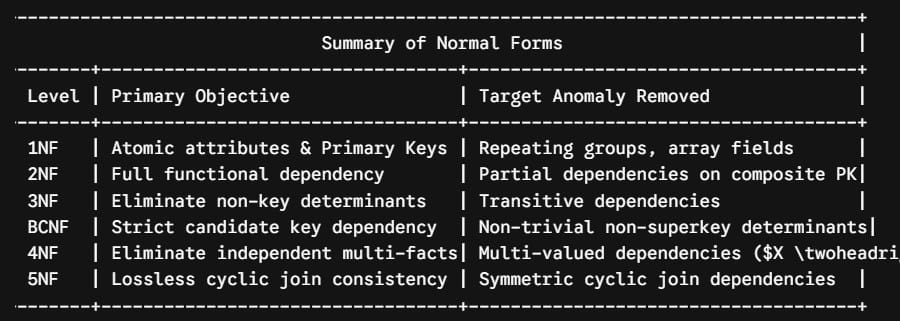
Fourth Normal Form (4NF)
A relation is in 4NF if:
- It is in BCNF.
- It contains no multi-valued dependencies ($X \twoheadrightarrow Y$).
A multi-valued dependency exists when the presence of two or more independent multi-valued attributes for the same determinant forces the table to store all Cartesian product combinations of those values.
- Example: If an engineer (e.g., Brandon Scott) has 3 independent certifications (AWS, Azure, GCP) and manages 3 independent projects (Apollo, Titan, Vulcan), storing them in one table requires $3 \times 3 = 9$ rows.
- 4NF Solution: Split into two independent tables:
EmployeeCertifications(EmployeeID, Certification)andEmployeeProjects(EmployeeID, ProjectID).
Fifth Normal Form (5NF / Project-Join Normal Form)
A relation is in 5NF if:
- It is in 4NF.
- It cannot be non-loss decomposed into smaller tables without join dependencies.
5NF handles symmetric constraints where data can be split into three or more separate relations and reconstructed without generating spurious tuples.
Best Practices
- Design in 3NF by Default: Always model your transactional application schemas in 3NF or BCNF during the conceptual and logical phases.
- Use Surrogate Keys Wisely: Use auto-incrementing integers or UUIDs as primary keys, but do not omit unique constraints on natural candidate keys.
- Index Foreign Keys: Normalization decomposes data across multiple tables. To prevent performance bottlenecks during
JOINqueries, ensure foreign key columns are indexed. - Denormalize Consciously, Not Lazily: Never skip normalization out of convenience. Denormalize only after query profiling shows that specific joins are degrading application performance under heavy read traffic.
- Enforce Referential Integrity: Use database-level
FOREIGN KEY ... ON DELETE/UPDATEconstraints rather than relying solely on application-layer logic to prevent orphaned records.
Designing an optimal schema requires balancing operational write performance, data integrity, and analytical read patterns. Mastering the mechanics of 1NF through 5NF ensures your data model remains resilient, maintainable, and anomaly-free as your system scales.
You may also like the following articles:

After working for more than 15 years in the Software field, especially in Microsoft technologies, I have decided to share my expert knowledge of SQL Server. Check out all the SQL Server and related database tutorials I have shared here. Most of the readers are from countries like the United States of America, the United Kingdom, New Zealand, Australia, Canada, etc. I am also a Microsoft MVP. Check out more here.